
Op. 37a: Callirhoë (Ballet Symphonique)
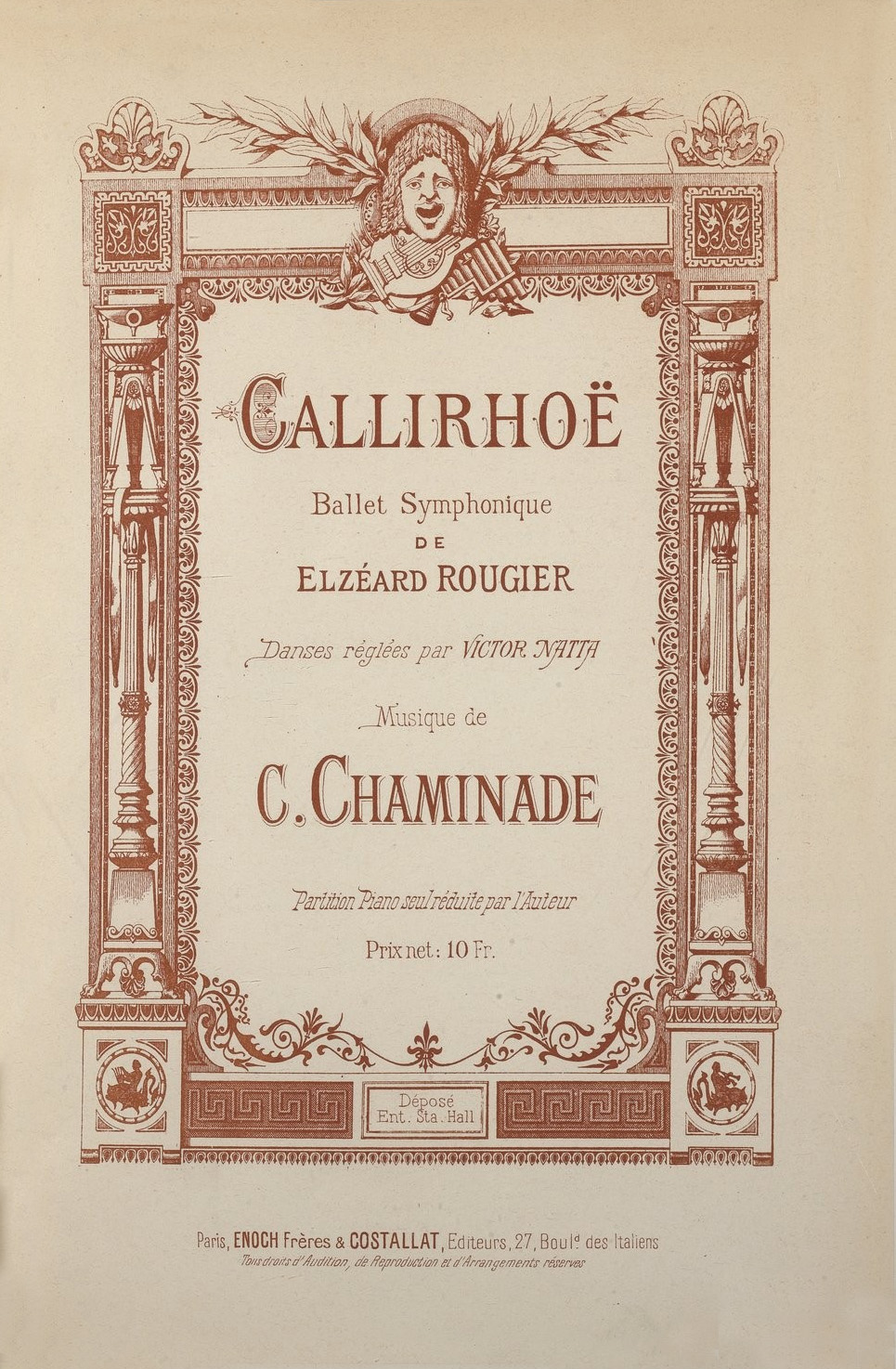
Publisher: Enoch
Date: 1889
Instrumentation: piano
Dedicated to Édouard Brunel. Enoch plate 1505.
Premiere at the Grand Theatre de Marseille on March 16, 1888. There are 21 pieces and all are transcribed for piano by Chaminade, easy piano by Weyler.
1. Prélude (published as Movement I of Orchestral suite Op. 37b)
2. Scherzo
3. Pas des Amphores (published as 2nd air de ballet for solo piano, later transcribed to easy piano by Weyler, Enoch plate 2178)
4. Entrée d’Alcméon
5. Pas des Écharpes (together with Pas du voile published as Movement II of Orchestral suite Op. 37b)
6. Pas du voile (together with Pas des Écharpes published as Movement II of Orchestral suite Op. 37b)
7. Orage (Musique de scène)
8. Marche Sacrèe
9. Musique de scène
10. Scherzetto (later transcribed for two pianos, with the addition of 32 introductory measures, retitled Scherzettino, and published as Op. 59.)
11. Musique de scène
12. Andante (later transcribed for two pianos and solo piano by Chaminade with the same title as Op. 59)
13. Pas Guerrier
14. Variation (later published as Quatrième Air de Ballet for piano, simplified version by Weyler)
15. Danse orientale (later published as with Danse Pastorale as piano four hands as Deux Airs de Ballet)
16. Valse
17. Musique de scène
18. Musique de scène
19. Scène et danse pastorale (Danse Pastorale later published with Danse Orientale as piano four hands as Deux Airs de Ballet)
20. Musique de scène
21: Valse finale
The Pas des Écharpes (Scarf Dance) is taken from my ballet-music to “Callirhoe;” it requires a well-marked rhythm, like all music written primarily for theatre dancing. The two strongly contrasted themes from which it is constructed need to be played very distinctly. The first part, in A flat, requires sonority, “the charm of sound” (le charme du son); in the orchestra it is announced by violins; it should be played with a mellow, ringing tone, and while always maintaining a moderate waltz rhythm in strict tempo, this characteristic theme should always be played with a slight
“Rubato.” The second part, in 2-4 rhythm, introduced in the orchestra by a few bars of recitative for the oboe, is full of melancholy. Here, above all, it is necessary to make the piano “sing” with a clinging touch, yet, at the same time, keeping the hand very supple, so that the tone shall be full and penetrating. The part which precedes the return of the first subject should be played with abandon, rapidly, brilliantly, slowing a little towards the end, and when the first subject, in A flat, makes its reappearance there should be a slight pause before taking up the theme. (Chaminade, Cécile. “How to Play My Best Known Pieces.” The Etude 26 (December 1908): 759–760.
The “Pas des Amphores,” (Air de Ballet No. 2) another extract from “Callirhoe,” is, contrary to the first, lively, brisk and light in character. At the beginning, for instance, the first chord ought to be “sec” (sharp, clear cut, “dry”) and “fortis¬
simo;” the note F that follows brings us to a pause which ought to be well sustained. The whole rhythmic design of the first part is well contrasted with the second, in which full value should be given to the notes, and which should be played without haste. (Chaminade, Cécile. “How to Play My Best Known Pieces.” The Etude 26 (December 1908): 759–760.)
Pas des Amphores transcribed to piano four hands by Steiger in 1897 (Enoch 3378). In the piano reduction, version of Op. 37 Echarpes is no. 5;
Pas des Amphores is No. 3: easy piano by Weyler piano four hands:
Danse Orientale and
Danse Pastorale: easy piano by Weyler
Pas des Amphores,
Pas des Echarpes: easy piano by Weyler
Callirhoe (variation): easy piano by Weyler