
Op. 123: Album des Enfants (première série)
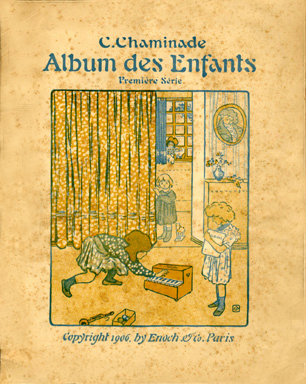
This collection comprises twelve short piano pieces designed for young pianists.
- Prélude
- Intermezzo
- Canzonetta
- Rondeau
- Gavotte
- Gigue
- Romance
- Barcarolle
- Orientale
- Tarentelle
- Air de Ballet
- Marche Russe
No. 3 features a simple melody accompanied by eighth notes in the left hand. The time signature is 4/4.
No. 5 is a contredanse, a popular dance form of the late eighteenth and early nineteenth centuries. This piece is written in compound duple meter (6/8).
No. 9 is not written in a conventional major or minor key. It opens with a suggestive sense of E minor in the left hand, while the right hand introduces a scale beginning on E with F-sharp and C-sharp, creating an ambiguous modal sonority.
No. 10 is a lively folk dance in the style of a tarantella, traditionally associated with the belief that dancing could cure the effects of a tarantula’s bite. According to various versions of the legend, performing the dance served as an antidote to the spider’s venom. Characteristic musical features of the tarantella include repeated notes, the alternation of a note with its upper or lower neighbor, scalar passages, leaps, and arpeggios. The piece follows a ternary (ABA) form, featuring a significant modulation from A minor to C major and back to A minor: A (mm. 1–17), A minor; B (mm. 18–29), primarily C major with a brief excursion to G major, returning through C major to A minor; A (mm. 30–52), A minor.