
Op. 79b: Le Matin
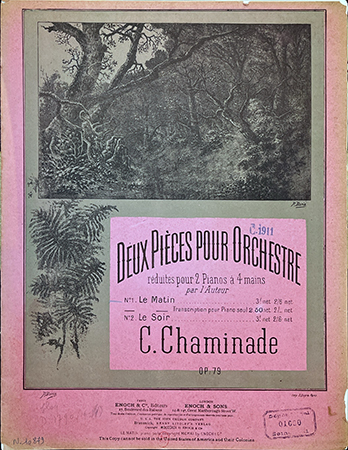
Publisher: Enoch
Date: 1911
Instrumentation: piano
Op. 79, titled Deux Pièces pour Orchestre (Two Pieces for Orchestra), consists of two contrasting movements: Le matin (Morning) and Le soir (Evening). Although conceived for orchestra, the two pieces were never published in their original orchestral form. The work reflects Chaminade’s gift for lyrical melody and refined instrumental color, and the two movements function as character pieces, with Le matin conveying freshness and brightness of a new day, while Le soir evokes a more reflective, atmospheric mood of twilight. Chaminade frequently transcribed her works and published them in multiple alternative formats, a practice that contributed significantly to their wide dissemination. Two contrasting piano miniatures that capture the moods of day and night.
Le matin and Le soir were first published for two pianos in 1895; Le matin later appeared in versions for piano solo in 1911, piano four hands in 1923, and violin and piano in 1925. These transcriptions allowed Op. 79 to circulate well beyond the orchestral concert hall, finding a place in salon, teaching, and recital settings. This approach is very characteristic of Chaminade’s compositional practice and reflective of her international reach as a composer.
Le matin opens with a prolonged G major sonority articulated through first-inversion chords, neighbor motion, and gentle predominant color, rather than through assertive dominant–tonic articulation. Harmonic motion unfolds gradually, with chromatic tones functioning primarily as passing or neighboring inflections that never threaten the tonal center. Cadences are frequently softened or evaded, creating a sense of suspension and continuity that suggests the gradual emergence of morning light rather than formal closure. A contrasting B section introduces an unexpected modulation to B-flat major, a mediant-related key that provides warmth and coloristic contrast without disrupting the work’s overall tonal clarity. The subsequent section begins in D major, the dominant key, where harmonic activity becomes more directed and energized. Here Chaminade employs clearer dominant preparation, sequential motion, and secondary dominants. This expansion of the dominant area serves not as a dramatic climax, but as a gentle amplification that prepares the return of the opening material in G major. In its reprise, the A section incorporates increased chromaticism and richer inner-voice activity, suggesting the transformation of morning as time unfolds. In the final measures, tonic harmony is prolonged through traditional plagal and dominant–tonic gestures, bringing the work to a calm and unambiguous close in G major. Throughout Le matin, harmony functions less as a vehicle for tension and resolution than as a means of sustaining atmosphere and color. Chaminade’s use of chromatic inflection, mediant relationships, and her avoidance of emphatic cadences together produce a harmonic language that is luminous, fluid, and evocative, closely aligning musical structure with the work’s poetic depiction of morning.
FORM
ABCABCoda
A = mm. 1–37 (G major)
B = mm. 38–49 (B-flat major)
C = mm. 50–66 (D major)
A = mm. 67–101 (G major)
B’ = mm. 102–120 (C major)
Coda = mm. 121–134 (G major)