
Op. 107a: Concertino
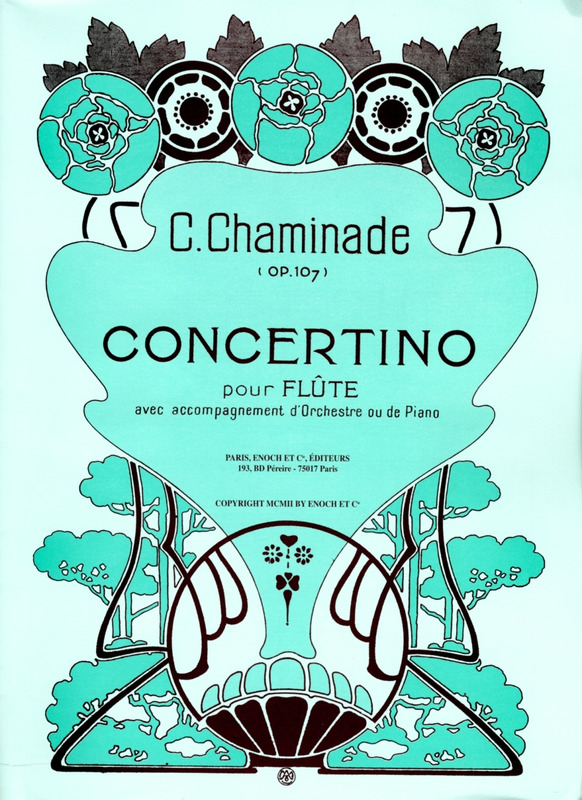
The Concertino was commissioned in 1902 by Théodore Dubois, director of the Paris Conservatoire, who asked Chaminade to compose a technically challenging piece for the flute students participating in the annual awards competition. At the same time, he also requested a work for the sight-reading test. The score is dedicated to Paul Taffanel, professor of flute at the Conservatoire.
In a 1934 interview, Chaminade admitted that she had “set about the work with rather bad grace,” noting that she would have preferred to compose for the violin or piano. “It seems to me rather melancholic that I entered the Conservatoire repertoire with a composition for the flute,” she said. Nevertheless, by providing the instrument with such a superb work—combining lyricism and virtuosity—she ensured that it would achieve widespread performance.
Published in 1902, the Concertino quickly moved beyond its academic context to great success in the concert hall. In 1906, it was performed at a gala at the Trocadéro in Paris by Adolphe Hennebains, accompanied by a 150-piece orchestra. This orchestrated version, prepared by Chaminade herself, was published by Enoch in 1908, becoming the composer’s final symphonic work.
Cast in a single continuous movement, the Concertino flows seamlessly from a graceful, song-like opening to passages of sparkling virtuosity, richly colored modulations, and dazzling cadenzas.
Cast in a single continuous movement, the Concertino flows seamlessly from a graceful, song-like opening to passages of sparkling virtuosity, richly colored modulations, and dazzling cadenzas.