Op. 19a: La Sévillane (Overture)
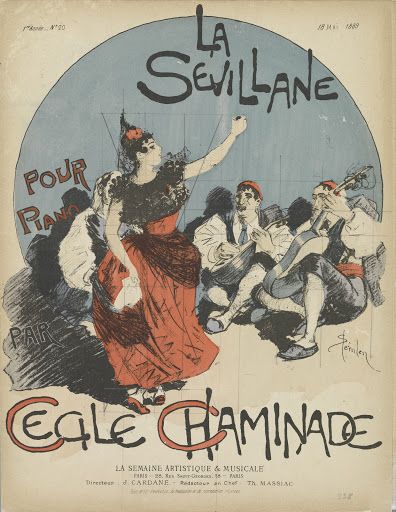
Publisher: Artistique et Musicale
Date: 1889
Instrumentation: Piano
Inspired by the Sévillane, a traditional Andalusian dance, the work captures the spirit of southern Spain through rhythmic vitality, bright harmonies, and spirited figurations.
La Sévillane originated as the overture to Cécile Chaminade’s one-act opéra-comique of the same title, composed in 1882. Its publication history is unusual. A piano transcription of the overture was first issued by La Semaine artistique et musicale on May 18, 1889 (plate A. S. 7), predating the publication of the two-piano version. The latter was subsequently published by Enoch & Costallat in 1891 (plate E. & C. 1898). In 1923, Enoch & Cie. published a later solo-piano version (plate E. & C. 8226), identified as a transcription based on the two-piano version. Thus, the 1923 piano edition represents a later stage in the work’s transmission rather than simply a reissue of the 1889 piano transcription. Since the 1889 piano version predates the two-piano version, the relationship between the two piano editions requires direct comparison; the 1923 version may represent a new solo-piano reduction derived from the 1891 two-piano version rather than a reprint of the earlier 1889 transcription.
The original orchestral score of the overture, including the autograph source (WU 26), was never published. The two-piano reduction, engraved and published by Enoch & Costallat in 1891 (plate E. & C. 1898), therefore constitutes the principal surviving published source for the work.
Transcriptions
Piano: An earlier piano transcription was published by La Semaine artistique et musicale in 1889 (plate A. S. 7). A later solo-piano transcription, based on the two-piano version, was published by Enoch & Cie. in 1923 (plate E. & C. 8226).
Orchestra: by Rudd in 1932