
Op. 55: Six Pièces Romantiques
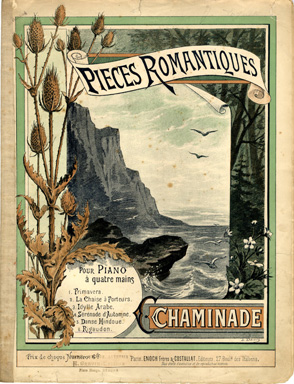
This is one of the only two piano duets that Chaminade wrote originally. All the other piano duets are transcriptions of her previous compositions. She wrote this set of six pieces for piano duets written in 1890 when she was 33 years old. At this time, she already has published her Piano Sonata, Six Concert Etudes, and Concertstück. Chaminade dedicated each of these pieces to a different female pianist. Some of the pieces were later transcribed to other instruments such cello and piano This is inline with her frequent practice of transcribing her own pieces. The autograph is still owned by the family.
No. 1, ‘Primavera’ (‘Spring’): Dedicated to Madame Breton-Halmagrand. A time of rebirth, renewal and awakening. This piece in FM is in ABA form with a codetta. In the A section: we have a lovely melody in FM, 8 m. period. Followed by a B section in AM with a pedal point. The boundary of B to A is obscure. The secondo mostly provides the harmonies in broken chords, allowing the music to flow expressively. E. & C. 1781.
No. 2: La Chaise à Porteurs (The Sedan Chais): Dedicated to Madame Adolphe Rehberg. Named after the town of Sedan in France where it was first used, the sedan chair is carried by two men known as ‘chairmen’, one at the front and one at the rear. The passenger would get in and out through a hinged door at the front of the chair. This type of transportation is definitely not recommended for those who suffered with motion sickness, as sedan chairs swayed and bounced, especially when conveyed at speed through the streets!
The music again is very charming, clear 4 measures phrases. The fleeing quality is being provided by the secondo eighth note movements. RH melody very scale wise. The piece goes through a lot of different key areas from Am to GM to em etc. E. & C. 1782.
No. 3, Idylle arabe (Arabian Idyll): Dedicated to Madame Fabre. composers of the time are drawn to exoticism.Composers writing pieces that evoke distant cultures through stylized rhythms, modal inflections, and ornamentation, rather than authentic representation. This piece begins with a 4 m. introduction setting the mood of foreign land, peaceful, quiet moment. The drone bass and the added 6th added the exoticism in this piece. Occasionally we hear the sound of cymbals crashing in the background. E. & C. 1783.
No. 4, Sérénade d’automne (Autumn Serenade): Dedicated to Madame Th. Dubois. The lyrical and somewhat melancholic melody depicts Autumn very effectively. evoking the peacefulness and melancholy of autumn. Yet sometimes it is being disturb by some stormy weather. E. & C. 1784.
“One of my favorite compositions, ‘Sérénade d’Automne’ was not a day dream but a real dream, as so many of them are” (“Mme. Chaminade’s Dreams” The Sun, November 1, 1908 p. 2).
No. 5 Danse Hindoue (Hindu Dance): Dedicated to Madame Ducatez-Lévy. A prominent pedal point in A minor creates a drone-like bass, with relatively sparse harmonic movement. The texture features a folk-like melody, rhythmic, and short repeated blocks. This brilliant and incisive piece uses the full range of the keyboard. The melody has a distinctly folkloric character, while waves of energetic sixteenth-note figuration give rise to a surging line in the second piano. The music suggests a theatrical dance setting. E. & C. 1785.
.
No. 6: Rigaudon: Dedicated to Madame Lyon. This final piece captures the spirit of the traditional French Baroque dance through lively rhythms, characteristic accents, and elegant ornamentation. Although designated a rigaudon, its graceful character and balanced phrasing suggest affinities with the gavotte. Rounded binary: 1st part is repeated, a digression, a sequential idea, V/ii ii then V I.. Rounded binary: 1st part is repeated, a digression, a sequential idea, V/ii ii then V I. E. & C. 1786.
Transcriptions
Piano
1. Primavera: transcribed by Weyler (E. & C. 2182).
2. La Chaise à Porteurs: transcribed by E. Tavan in 1893 (E. & C. 2183).
3. Idylle Arabe: transcribed by Chaminade in 1923 (E. & C. 8254).
4. Serenade Automne: transcribed by Weyler in 1893 (E. & C. 2206).
5. Dance Hindoe: transcribed by Chaminade in 1923 (E. & C. 8255).
6. Rigaudon: transcribed by Chaminade in 1923 (E. & C. 8256).
Easy piano
1. Primavera
2. La Chaise à Porteurs: by
4. Serenade Automne
Violin (or cello) and piano
2. La Chaise à Porteurs: by Chaminade in 1896 (E. & C. 2825).
Clarinet and piano
2. La Chaise à Porteurs: by Philippe Paquot
Orchestra
2. La Chaise à Porteurs: arranged for piano and clarinet by Philippe Paquot; anonymous orchestral arrangement published by Enoch; Chaminade’s own orchestration remains unpublished (WU8).
3. Idylle Arabe: anonymous orchestral arrangement published by Enoch; Chaminade’s own orchestration remains unpublished (WU10).
4. Serenade Automne: anonymous orchestral arrangement published by Enoch; Chaminade’s own orchestration remains unpublished (WU25).
5. Dance Hindoe: anonymous orchestral arrangement published by Enoch??
6. Rigaudon: anonymous orchestral arrangement published by Enoch.
O