Op. 61: Arabesque
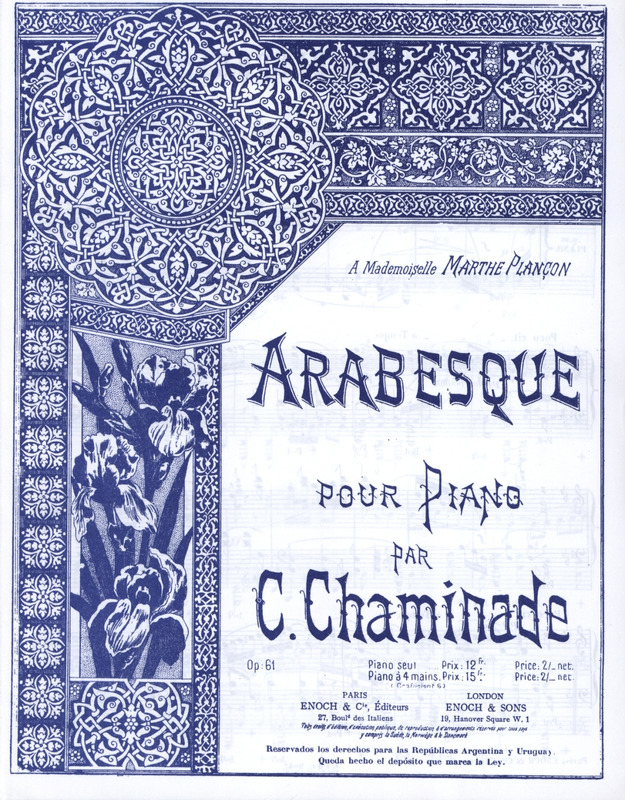
Dedicated to Marthe Plançon. Chaminade’s Arabesque plays with flowing melodic lines and the constant interplay between minor and major. This contrast is heard from the very beginning: the piece opens in G minor before gently easing into G major with a ritardando. The idea returns throughout the piece, creating a sense of continual movement between melancholy and warmth without ever becoming predictable.
As the title suggests, the Arabesque is full of flowing, decorative lines—musical curlicues that weave in and out with grace and subtle surprises. The piece is in ternary form (A–B–A’).
A section — G minor → G major
The opening is delicate and wistful, immediately establishing the minor–major ambiguity that defines the piece. It begins in G minor but cleverly shifts into G major by the end of the phrase, creating a sense of warmth blooming out of melancholy. This back-and-forth continues throughout the section, giving the music an expressive, almost improvisatory quality—like a thought that never quite settles.
‘
The contrasting B section is a brief episode that moves through brighter harmonies and a more rhythmically animated texture. The left hand provides a lilting accompaniment, while the right hand traces elegant, arching lines. The mood remains tender, but there is also a hint of playful energy. E. & C 2047
Transcriptions
Piano four hands: by Charles Steiger in 1897 (plate no. E. & C 3366).
Very easy piano: in Les Debuts du Pianiste 1909 (plate no. E. & C. 6733)